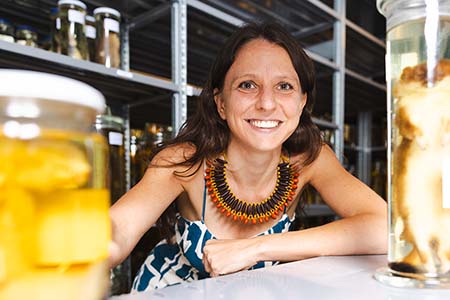
Conférence invitéeFor this edition, we are delighted to welcome Anne-Claire Fabre as our guest speaker.
Anne-Claire Fabre is an evolutionary biologist and functional morphologist focusing on shape evolution in an ecological context across vertebrate systems. Her research on micro- and macro-evolution integrates a wide range of biological disciplines. She aims to understand the evolution of morphology in space and time in relation to its development, function, ecology, behaviour, and changes in the environment. To do so, she integrates cross-disciplinary approaches such as functional morphology, evolutionary biology, behaviour, imaging, geometric morphometrics, biomechanics, phylogenetic comparative analyses, and spatial modelling on large comparative datasets coupled to the quantification of ecology of animals in their natural environment.
Presentation: The Metamorphic Blueprint: How life cycle strategy shapes salamander skulls A-C Fabre (1,2), V. Louppe (1,2), I. Toussaint-Lardé (1,2,3), M. Fournier (1,2), J Clavel (4), F. Condamine (5), A. Herrel (3) 1. Institute of Ecology and Evolution, Universität Bern, Bern, Switzerland 2. Naturhistorisches Museum Bern, Bern, Switzerland 3. Mécanismes Adaptatifs et Evolution, UMR 7179, Muséum national d'Histoire naturelle CNRS, Paris, France 4. Laboratoire d'Ecologie des Hydrosystèmes Naturels et Anthropisés, Université Lyon 1, CNRS, UMR 5023 ‐ LEHNA, Villeurbanne, France 5. Institut des Sciences de l’Evolution de Montpellier, CNRS, UMR 5554, Université de Montpellier, Montpellier, France Salamanders and newts exhibit the greatest diversity in life cycle strategies among tetrapods. Remarkably, they have independently evolved different developmental modes multiple times, resulting in distinct ontogenetic trajectories. Some species follow a complex, biphasic life cycle, transitioning from aquatic larvae to terrestrial adults and exploiting different environments at each stage. Others show direct development, bypassing the larval stage entirely and hatching as terrestrial, adult-like juveniles. Paedomorphic species, by contrast, retain larval traits and remain fully aquatic even after reaching reproductive maturity. This spectrum of life cycle types, provides an ideal framework for testing how developmental pathways influence diversification, morphological and functional diversity. Specifically, it allows us to explore whether developmental strategies act as a driver of biodiversity. Given the diversity in lifestyles and feeding strategies among salamanders, we expect ontogenetic shifts to be reflected in morphological changes, particularly in the head. The head is a highly complex and integrative structure: it supports sensory input, protects the brain, and plays a central role in feeding. In this presentation, we focus on cranial morphology and how it evolves across life stages in relation to changes in feeding ecology. Using an interdisciplinary approach, combining functional morphology, developmental biology, macroevolutionary analyses, and statistical modeling, we investigate how life cycle complexity influences morphological diversification. Our results indicate that life-cycle strategy strongly influences morphological patterns, at times constraining and at other times promoting morphological evolution. Nevertheless, additional factors, such as environmental conditions and biogeographic history, also drive their diversification and functional diversity.
|